

Air pollution control systems play a critical role in keeping industrial boilers operating efficiently, yet they are often viewed only through the lens of emissions compliance. Jeff Chudd, an air pollution control expert at ProcessBarron, explains that equipment such as electrostatic precipitators, baghouses, ductwork, and industrial fans directly influence airflow, draft stability, and energy consumption throughout the plant.
The Overlooked Link Between Emissions Control and Energy Costs
When facilities consider improving boiler efficiency, the focus typically falls on combustion tuning, fuel quality, or heat transfer surfaces.
However, one of the most overlooked contributors to boiler performance lies downstream of the boiler itself, the air pollution control system.
Electrostatic precipitators, dust collectors, scrubbers, ductwork, and industrial fans not only control emissions but also play a crucial role in maintaining a safe and healthy work environment. They play a critical role in fuel consumption, draft stability, and overall energy costs.
As Jeff Chudd explains:
“One of the most overlooked drivers of boiler performance is the air pollution control system within the downstream air system. If that system isn’t optimized, the boiler is almost always burning more fuel than necessary.”
Understanding this connection is essential for facilities looking to improve efficiency while maintaining emissions compliance.
The Boiler–Air System Relationship
A boiler does not operate independently. Instead, it functions as part of a complete airflow system.
In a typical industrial operation:
- Combustion air enters the boiler
- Fuel burns to generate heat
- Flue gas exits through ductwork
- Air pollution control equipment removes particulates
- Induced draft (ID) fans pull gases through the system and out the stack
Every component in this system creates resistance.
When resistance increases anywhere along the path, the entire system must work harder.
According to Chudd:
“If resistance increases anywhere in the air path, the whole system has to compensate. That means higher fan horsepower, increased fuel usage, and reduced combustion efficiency.”
Over time, these inefficiencies translate directly into higher operating costs and greater equipment wear.
How Pressure Drop Drives Up Energy Costs
One of the most common hidden causes of energy loss is excessive pressure drop across air pollution control equipment.
When the pressure drop exceeds the system design parameters:
- ID fans must operate at higher speeds
- Motor amperage increases
- Electrical consumption rises
- Draft control becomes unstable
Even a relatively small increase in system resistance can have a significant impact. “A small increase in pressure drop might not seem like much,” Chudd notes, “but over time it can dramatically increase electrical demand and force the system to work much harder than it was designed to.”
Common Causes of Air System Resistance
Several issues can increase system resistance and reduce overall efficiency.
Baghouses
- Blinded or aging filter bags
- Improper air-to-cloth ratios following operational changes
Electrostatic Precipitators
- Poor cleaning system performance
- Excessive particulate buildup
Ductwork and Air Systems
- Corrosion or erosion creates restrictions
- System modifications introducing new airflow limitations
Returning pressure drop to design conditions often leads to immediate energy and performance improvements.
Air Leakage: A Hidden Efficiency Drain
Air leakage is another common but often overlooked source of inefficiency.
Leaks frequently occur in:
- Air heaters
- Ductwork
- Expansion joints
- Equipment casings
These leaks increase the total volume of gas moving through the system.
The result:
- Higher fan energy consumption
- Lower gas temperatures
- Increased corrosion risks
- Reduced particulate collection efficiency
Chudd emphasizes the impact of these leaks:
“In many older systems, duct leakage alone can account for significant efficiency losses. When you seal those leaks and restore the system balance, you can see immediate improvements in fan load and overall performance.”
Real-World Results: Improving Air System Performance
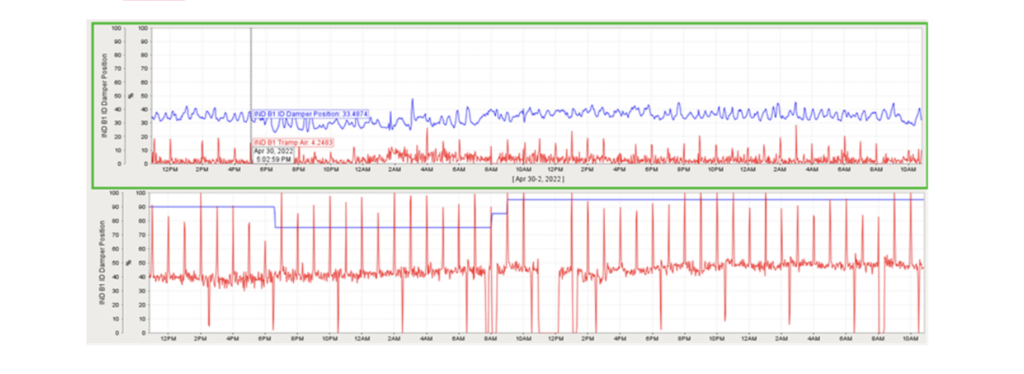
Following the project:
- The ID fan load dropped from 100% to 60%
- Steam production increased from 160 klb/hr to 200 klb/hr
- The facility was able to increase biomass firing capacity
Reducing airflow resistance allowed the plant to operate closer to its intended design performance.
Why Industrial Fan Performance Matters
Industrial fans are essential for maintaining stable airflow and draft conditions.
However, many fans operate far below their intended efficiency due to:
- Eroded impellers
- Incorrect blade angles
- Poor inlet or outlet design
- Changes in system operation over time
When fan efficiency drops, electrical demand increases, and boiler tuning becomes more difficult.
“Industrial fans are often incorrectly sized or operating far from peak efficiency,” Chudd explains. “When that happens, the system has to use more electrical power just to move the same amount of air.”
Upgrading or rebuilding fans can restore efficiency and improve combustion stability.
The Role of Electrostatic Precipitators in Boiler Efficiency
Electrostatic precipitators (ESPs) are often viewed solely as emissions compliance equipment.
But their performance directly affects system pressure, airflow stability, and overall energy consumption.
Poorly tuned ESP systems can lead to:
- Higher auxiliary electrical loads
- Increased system resistance
- Draft instability
- Higher fuel costs
“When precipitators aren’t properly tuned, the result isn’t just higher emissions,” says Chudd. “It can also mean increased power consumption and unstable system pressure.”
Modern digital controls allow operators to optimize voltage levels, reduce spark rates, and improve particle collection efficiency.
Another real-world case study is when we worked to improve Precipitator removal efficiency to remain in compliance with emission standards, while production capacity was simultaneously increased. Mid-Frequency Power Supply controls were installed on the first two electrical fields.
As can be seen below, opacity was drastically improved with the introduction of the Mid-Frequency Power Supply controls, while allowing the cement facility to increase its production to full capacity.
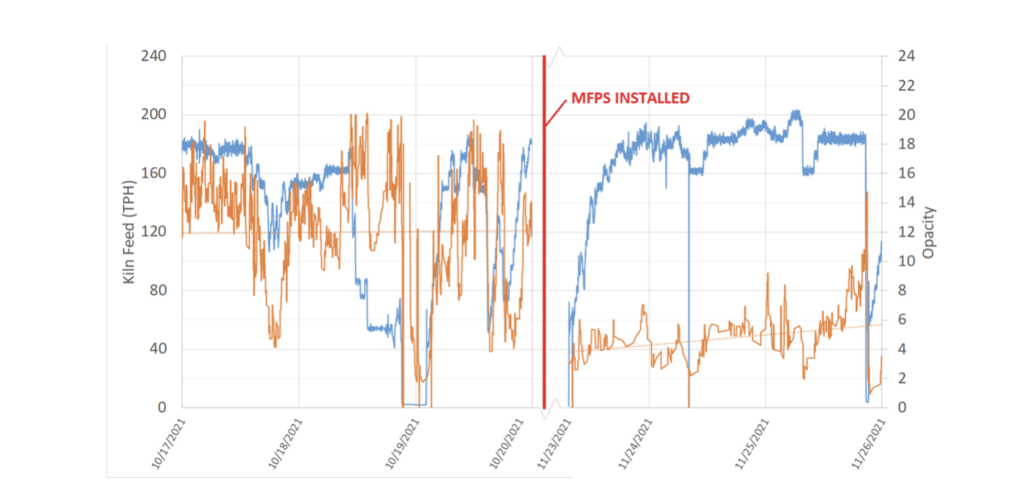
The diagram above illustrates the effect of a Mid-Frequency Power Supply
implementation by ProcessBarron.
Paper Mill Case Study: Power Boiler Precipitator
ProcessBarron worked to tune controls on a Power Boiler Precipitator at a Paper Mill, to lower opacity at the stack, and to help improve overall boiler and air system performance and efficiency.
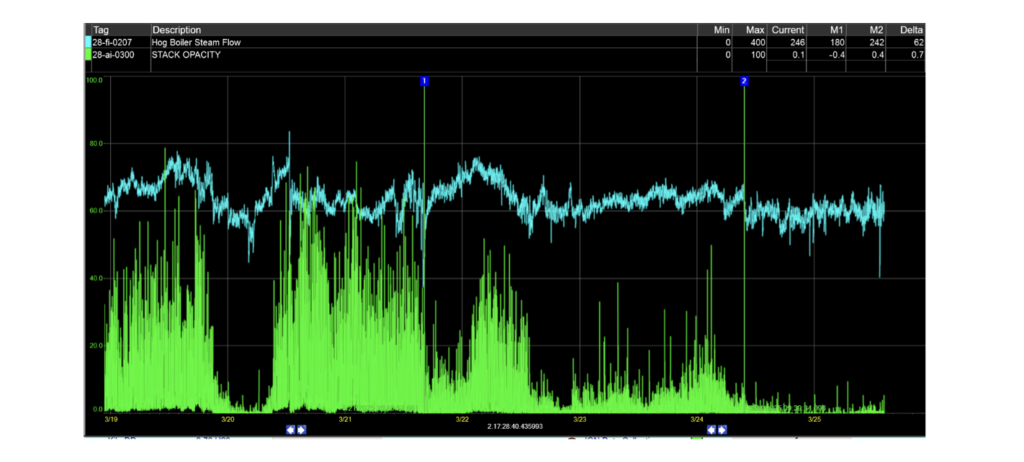
The image above illustrates opacity improvements after ProcessBarron’s controls tuning.
Draft Stability and Combustion Performance
Boilers rely on stable negative pressure to operate efficiently.
If precipitator operation causes sudden flow restrictions or instability, operators often compensate by increasing excess air.
While this may improve safety margins, it also reduces efficiency by:
- Lowering flame temperature
- Increasing stack losses
- Raising fuel consumption
Maintaining stable air system performance allows operators to maintain tighter combustion control.
The Financial Impact of Optimizing Emissions Systems
Facilities that treat air pollution control systems solely as regulatory equipment often miss significant efficiency opportunities.
Optimizing these systems can deliver measurable benefits, including:
- Reduced electrical consumption
- Lower fuel usage
- Improved combustion stability
- Fewer opacity excursions
- Extended equipment life
- Reduced emissions
In many facilities, energy savings alone can justify system upgrades.
Warning Signs Your Emissions System Is Reducing Efficiency
Operators should watch for indicators such as:
- Increasing fan amperage
- Rising stack temperatures
- Higher fuel consumption without increased production
- Unstable draft readings
- Increasing pressure drop across the equipment
- Frequent opacity spikes
“These are not just maintenance issues,” Chudd notes. “They’re energy issues.”
Addressing them early can prevent long-term efficiency losses.
Partner with ProcessBarron on APC
Boiler efficiency is about far more than combustion. The air pollution control system plays an active role in overall plant performance.
Facilities that treat emissions control as part of a holistic efficiency strategy, rather than simply a compliance requirement, often uncover meaningful opportunities to reduce both fuel and electrical costs.
If you’re looking to reduce operating costs, the air system may be the most overlooked opportunity in the plant. Contact a ProcessBarron sales representative near you to get your assessment.