
Expert Interview: Ashley Doyal, Vice President of Sales – South Region
Host: Jen Little, Director of Commercial Operations
Every day, millions of tons of garbage are discarded, but what if that waste could be transformed into electricity? Waste-to-energy (WTE) technology is doing exactly that, converting municipal solid waste into reliable power while reducing landfill dependency.
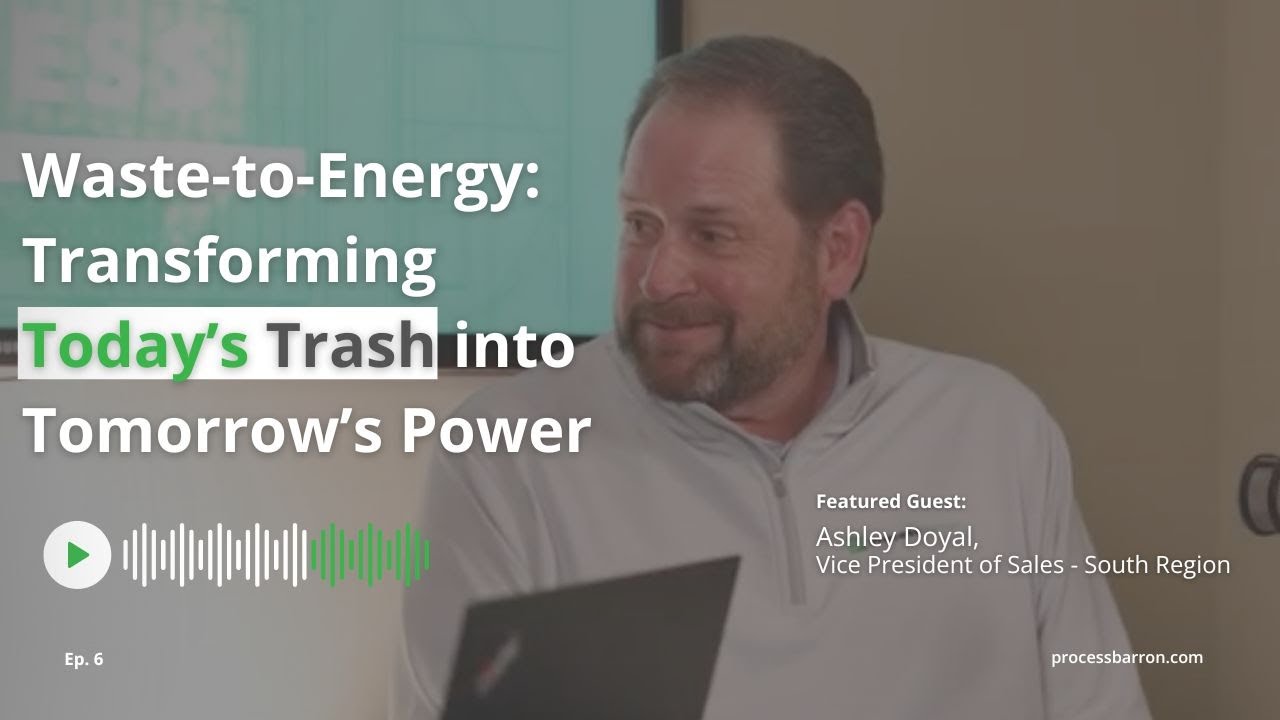
In this episode of Powering the Process, host Jen Little speaks with Ashley Doyal, Vice President of Sales – South Region of ProcessBarron, about how waste-to-energy plants operate, the environmental benefits they provide, and the critical systems that keep them running efficiently.
Waste-to-energy is a process that converts municipal solid waste into electricity through controlled combustion. Instead of sending garbage to landfills, facilities use it as fuel to produce steam, which drives turbines and generates power.
A typical facility processing about 2,200 tons of waste per day can generate 40–60 megawatts of electricity, enough to power up to 20,000 homes.
One of the biggest advantages of WTE technology is its impact on landfill reduction and emissions control.
1. Reduces Landfill Waste
Burning municipal waste decreases volume by roughly 90%, leaving only a small amount of ash for disposal or reuse.
2. Lowers Greenhouse Gas Emissions
Landfills produce methane, a potent greenhouse gas. Waste-to-energy reduces methane formation by diverting waste from landfills.
3. Supports Clean Energy Generation
WTE plants produce electricity that offsets fossil fuel use, contributing to energy diversification.
A persistent myth is that waste-to-energy facilities are harmful to the environment. In reality, modern plants are among the most regulated industrial facilities.
Advanced air pollution control systems ensure that nearly all emissions consist of oxygen, nitrogen, and water vapor, with strict monitoring in place to maintain compliance.
Efficient operation of waste-to-energy facilities depends heavily on engineered systems designed to handle extreme conditions.
These integrated systems ensure optimal performance, emissions compliance, and operational reliability.
Despite their benefits, WTE plants face several complex challenges:
Proper system design, material selection, and maintenance strategies are essential to overcoming these challenges.
Because waste composition varies widely, boilers and air systems must withstand corrosive conditions caused by plastics, metals, and chemical compounds.
Solutions include:
These measures extend equipment life and reduce maintenance costs.
As global waste production continues to rise, WTE technology is expected to play a growing role in sustainable resource management.
Future trends include:
Waste-to-energy is becoming a critical component of the circular economy by turning waste into usable resources.
Many WTE facilities generate enough power to operate independently while supplying surplus electricity to the grid. This helps municipalities:
With the United States producing more municipal waste than any other country, the demand for sustainable waste solutions will continue to grow.
Waste-to-energy facilities are expected to expand, driven by:
Waste-to-energy represents a powerful intersection of environmental sustainability and industrial innovation. By reducing landfill dependence, generating clean power, and supporting resource recovery, these facilities are reshaping how communities manage waste.
As technology advances, waste-to-energy will play an increasingly vital role in global sustainability and energy resilience.perts are often the difference between costly shutdowns and continuous production.
At ProcessBarron, our industrial equipment is built with precision, accountability, creativity, and people. It’s reflected in award-winning operations, advanced technologies, strong safety practices, and a culture committed to doing things the right way, every time.
Because in industrial manufacturing, innovation isn’t optional. It’s the standard.
Listen to more episodes!
Contact a ProcessBarron sales representative near you.